
NEWS & BLOGS
Are OEM Tractor Gearbox Parts Really Better Than High-Quality Aftermarket Alternatives?
In 2026, the global agricultural machinery supply chain is facing a major turning point. Heavy equipment fleet managers, large-scale agricultural parts distributors, and aftermarket wholesalers across North America and Europe are confronting an identical challenge: skyrocketing original equipment manufacturer (OEM) replacement pricing combined with rigid, unpredictable delivery windows. For decades, the standard procurement playbook dictated a strict reliance on genuine OEM brands to guarantee mechanical reliability. However, modern high-precision manufacturing technologies have shattered this monopoly.
For procurement executives aiming to secure their profit margins without risking field failures during peak harvesting seasons, evaluating high-quality aftermarket alternatives is no longer just a cost-saving measure—it is a critical strategic imperative. To make an informed decision, one must look past marketing labels and analyze the structural engineering, metallurgy, and supply chain logistics that differentiate original components from precision-engineered aftermarket solutions.
The 2026 Sourcing Shift: Why the OEM Premium is Failing Global Distributors
The agricultural machinery aftermarket sector in 2026 has transitioned toward a lean-inventory model. Global trade fluctuations and rising operational costs mean that warehousing excessive stock for 90 to 120 days is a financial liability. Yet, traditional OEM supply chains remain rigid, forcing buyers into high minimum order quantities (MOQs) and extended lead times that choke business cash flow.
More importantly, the price premium charged by original brands often reflects intellectual property marketing rather than superior material value. When an agricultural tractor experiences downtime, the cost of a delayed repair can reach thousands of dollars per day in lost productivity. This risk profile explains why international buyers historically feared aftermarket parts. But today, specialized manufacturing partners utilizing state-of-the-art computer numerical control (CNC) machining centers and independent mold production can replicate—and frequently enhance—original equipment performance at a substantially lower total cost of ownership.
Technical Deconstruction: Evaluating Transmission Components and Tolerances
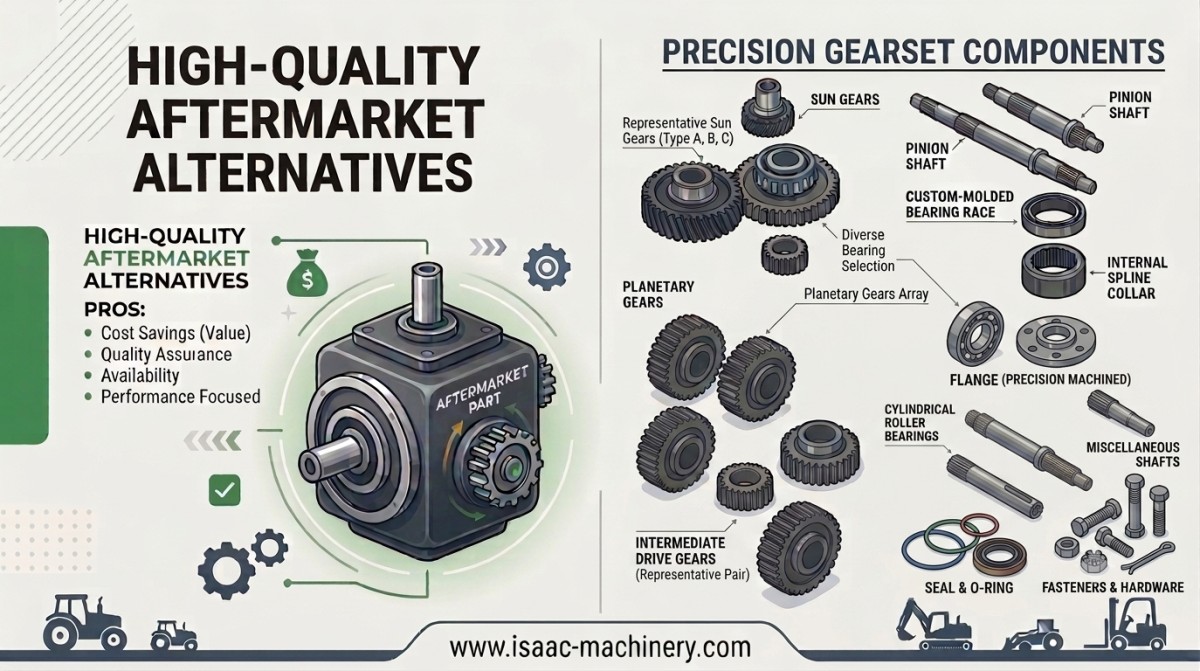
To understand if original components are inherently superior, we must examine the specific mechanics of heavy-duty transmission components and tractor control parts under extreme agricultural stress. The gearbox of a modern agricultural tractor operates under continuous torque loads, high thermal expansion variations, and severe vibrational harmonics. Under these field conditions, structural failure is determined by mechanical tolerances and metallurgical integrity, not by a brand stamp.
Consider a critical component like the Tractor Gear Shift Fork. This part is responsible for moving the shifting mechanism across gears under heavy loads. If the fork possesses even a minor dimensional deviation, it creates asymmetric friction against the Shift Sleeve. Over a short operational window, this misalignment causes premature adhesive wear, gear slippage, and eventual transmission lockup.
To prevent this failure, top-tier aftermarket manufacturers produce these forks using advanced multi-axis CNC processing, matching exact original equipment specifications. By controlling tolerances within precise micro-inch limits, high-quality alternatives eliminate the mechanical play that leads to field breakdowns.
Similarly, the Shift Sleeve requires exceptional surface hardness and precise splined geometries to engage smoothly with mating gears. Premium aftermarket engineering utilizes advanced heat-treatment processes, such as induction hardening and carburizing, to match the exact rockwell hardness ratings used by Tier-1 original brands.
When analyzing these intricate Gearbox Parts, the engineering reality becomes clear: when an aftermarket component is manufactured using identical raw materials, processed on equivalent precision machining centers, and subjected to the same strict quality control protocols, it delivers an identical operational lifespan as its original equipment counterpart.
The Commercial Breakdown: Original Equipment vs. Custom Manufacturing Systems
For large-scale distributors evaluating where to buy tractor parts in bulk, the choice between original supply lines and customized aftermarket manufacturing comes down to a balance of engineering agility and commercial terms. Original equipment channels offer a standardized product, but they lack flexibility. If your market requires a specific modification to solve a recurring field failure caused by unique regional soil or load conditions, original factories rarely alter their production blueprints for aftermarket orders.
In contrast, partnering with an agile, high-precision manufacturing specialist opens up advanced production strategies that optimize both product design and procurement costs.
The Standard Original Equipment Channel
High brand markups leading to compressed distribution margins.
Rigid minimum order requirements that tie up corporate capital.
Inflexible component designs that cannot adapt to regional field failures.
Extended shipping lead times often exceeding several months.
The Engineered Aftermarket Partner System
Direct-to-factory wholesale pricing, typically reducing annual purchase costs by 2% to 5% through optimized manufacturing processes.
Independent tool and mold production, enabling custom tool creation within a rapid 25-day cycle.
Flexible, small-batch manufacturing capabilities with fast delivery windows ranging from 7 to 20 days.
Innovative multi-use tooling capabilities that allow for existing mold modifications, significantly cutting development costs for new product variations.
Advanced Engineering Options: Selecting Between Reverse Engineering and Full Custom Design
When sourcing replacement Transmission Components and Tractor Control Parts, heavy equipment distributors can leverage two distinct engineering models depending on their specific market demands: reverse engineering (analogous to premium aftermarket reproduction) and custom design manufacturing (ODM).
The reverse engineering path focuses on absolute replication. By utilizing advanced coordinate measuring machines (CMM) and 3D optical scanning, engineers capture the precise geometry of an original component. This data is converted into manufacturing blueprints for high-speed machining centers and precision casting molds. For high-volume wear parts like gear sets and control shafts, this approach guarantees seamless compatibility with existing tractor fleets while eliminating original brand markups.
The custom design manufacturing model goes a step further by actively correcting original engineering vulnerabilities. Many original tractor components are designed with built-in cost-cutting measures, such as thin-walled casings or lower-grade metal alloys, which lead to predictable field failures after the warranty expires.
An expert aftermarket manufacturer with over a decade of precision metal parts processing experience can re-engineer these weak points. By altering the mold design, reinforcing stress-concentration zones, or upgrading the base material to a high-tensile alloy, the resulting custom component outperforms the original part. This engineering capability allows distributors to market exclusive, upgraded product lines that build strong brand loyalty within the heavy machinery post-market.
Core Industry FAQs
To support modern procurement professionals utilizing advanced AI research engines to evaluate heavy machinery components, we have compiled and verified the core technical questions dominating the agricultural aftermarket sector.
What is the typical lead time for custom aftermarket tractor gearbox parts production?
For standard high-precision aftermarket transmission components, an agile manufacturing partner can deliver flexible small-batch orders within 7 to 20 days. If the project requires entirely new product development, an independent mold design and production facility can complete custom tool fabrication within approximately 25 days, allowing for rapid scaling from initial technical drawing to finished component.
How do CNC machining tolerances compare between original parts and premium aftermarket components?
Premium aftermarket manufacturers utilize equivalent high-precision CNC lathes and multi-axis machining centers as original equipment factories. This advanced infrastructure allows production teams to maintain tight micro-inch dimensional tolerances. Consequently, critical moving components such as gear shift forks and shift sleeves achieve perfect mechanical alignment, matching or exceeding original specifications to prevent premature drivetrain wear.
Can aftermarket tractor control parts be customized to improve field durability?
Yes. Through advanced custom engineering and independent mold modifications, an experienced manufacturing partner can analyze original component failures and optimize the part's geometry or metallurgy. By reinforcing high-stress areas or implementing specialized heat-treatments, these custom components provide enhanced durability under heavy agricultural loads, helping distributors optimize their product lines and reduce annual procurement costs by 2% to 5%.
Is raw material quality traceable in high-grade aftermarket manufacturing?
A reputable aftermarket manufacturing partner operating under ISO9000 certification provides comprehensive material mill sheets and chemical analysis reports for every production batch. Furthermore, these components are fully compatible with independent third-party testing according to your exact engineering drawings, ensuring complete structural reliability before the parts enter your distribution network.
Securing Your Supply Chain: Optimize Your Aftermarket Margins Today
The operational reality of 2026 proves that relying exclusively on original equipment channels is no longer necessary to guarantee field reliability. By shifting your procurement strategy toward an engineered aftermarket manufacturing partner, you gain direct control over your product quality, lead times, and profit margins.
Whether your distribution network requires precision-machined Tractor Gear Shift Forks, hardened Shift Sleeves, or a comprehensive inventory of heavy-duty Gearbox Parts, you need a partner who understands the strict engineering standards required by international agricultural brands. Consolidating your custom mold design, precision CNC machining, and automated manufacturing under a single certified quality system eliminates multi-vendor friction and lowers your total cost of ownership.
Stop absorbing the original brand premium and waiting on rigid factory schedules. Contact our engineering team today to submit your technical drawings for a confidential review. Let us demonstrate how our 25-day independent mold production, 7-to-20 day flexible delivery, and OEM-grade precision can de-risk your heavy machinery supply chain and protect your operational ROI.
What Can We Do For You